Something Is Happening
Does anyone else get that feeling that something is happening but you can't quite put a finger on it? After more than a decade of doing something related to computers and computing, I can't shake the sense that we're in the middle of exactly this.
Does anyone else get that feeling that something is happening but you can’t quite put a finger on it?
Freud had a word for this. He called it das Unheimliche, often translated as the uncanny. It’s that unsettling sensation when something familiar suddenly feels strange. Not foreign. Not new. Just… off. The beauty of German is that it’s more precise than English allows: heimlich means homely or familiar, but it also means hidden or concealed. The uncanny is what happens when the hidden part of the familiar reveals itself.
The uncanny is that class of the frightening which leads back to what is known of old and long familiar.
After more than a decade of doing something related to computers and computing, I can’t shake the sense that we’re in the middle of exactly this. The tools I’ve used my whole career are still here. The terminal is still the terminal. Code is still code. Bugs too. And yet something underneath has shifted. On one side, it’s painfully obvious. On the other, it feels almost hidden, like a distant buzzing, an off-frequency just at the cusp of perceptible.
01 // Origins
My origin story starts in early 2000s Serbia, where widespread internet access was still a novelty. Kudos to my dad for pioneering wireless broadband in our bubble. He gave me access to the vastness of the internet before I had any idea what to do with it. We look up to the people nearby, and I wanted to be like him: know cool stuff, interact with the terminal, be the guy who could fix things.
So began my first dabblings with MikroTik routers, network switches, and servers. I was brute-forcing my way through. Much like an LLM, really. I didn’t understand what I was doing. I was pattern-matching. Imitating. Copying iptables rules from forums without grasping netfilter chains. Running chmod 777 because it fixed permission errors. Pasting .htaccess rewrites and later nginx configs that felt more like incantations and tribal magic than configuration. The sacred ritual of sudo make install followed by hope. First installs of Fedora. Bricking boot, recovering, asking for help, and having to start from scratch anyway. Many times.
Fast-forward through mIRC channels, MSN, and early YouTube. It feels like eons have passed. Those first steps feel like they were executed by someone else.
02 // The Friction That Taught Us
Why the lament for the past?
It’s not a lament. It’s an observation. And like any observation, it needs grounding.
With the newest workflows, vibe coding and the rest, something is ending that we won’t see again. And genuinely, that’s equal parts sad and scary.
One of the first lessons I got from more senior colleagues was simple: read and be patient. There was a certain passive-aggressive elegance to receiving a Let Me Google That For You link. It stung. It was meant to. Perhaps it was even needed. Stack Overflow became the great equalizer, the place where you could watch strangers argue about the correct way to center a div or whether tabs were morally superior to spaces (a war that auto-formatters mercifully ended). I even landed a gig and eventually moved to Germany through a connection I made there.
That era had friction, and the friction was the teacher.
How many times can I make the same mistake, debug it, and swear I won’t make it again… until it happens again.
Now? I genuinely don’t know how people new to technology learn and interact with it anymore. The answers come faster, but I’m not sure they stick the same way. When the solution arrives in seconds, fully formed and confidently explained, does it build the same intuition? Does it ring a bell of “oh, this might not be good”? Or does it just… dissolve? The hours lost in man pages built something that no autocomplete can replicate: patience and resilience.
The data tells a story too.
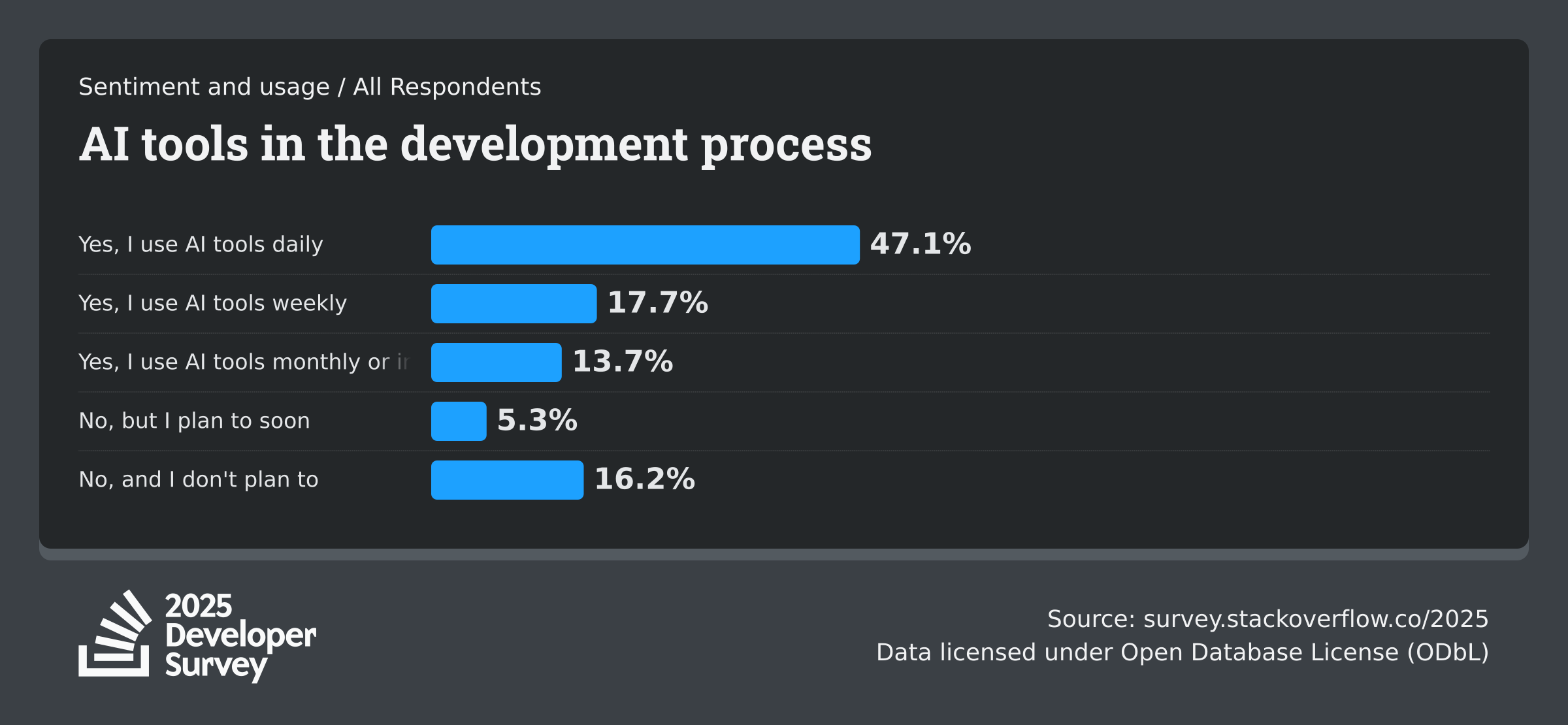
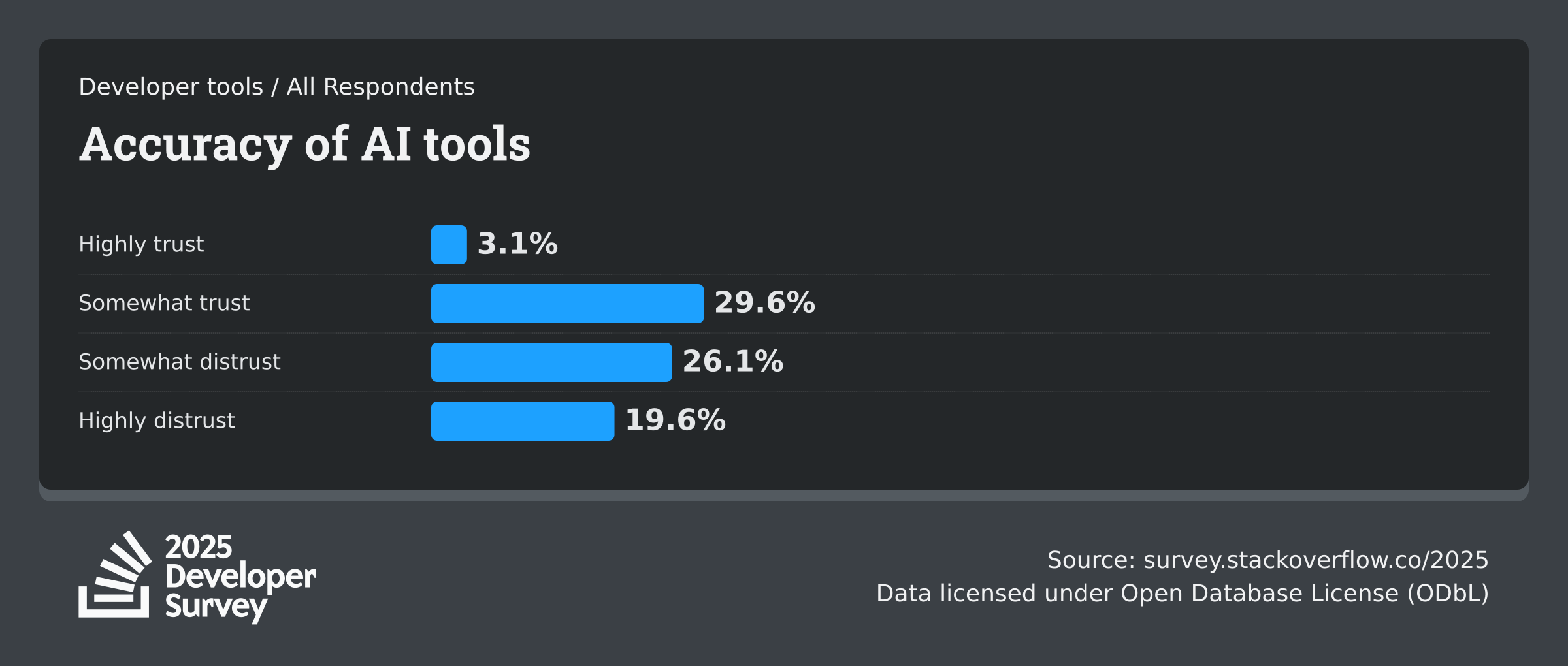
Stack Overflow’s traffic has collapsed since ChatGPT launched in November 2022. By December 2024, monthly questions dropped to ~25,000, levels not seen since the site launched in 2009. That’s a 70% decline from March 2023. The 2025 Developer Survey reveals an uncomfortable paradox: 84% of developers now use AI tools, yet only 33% trust the accuracy of AI output. 46% actively distrust it.
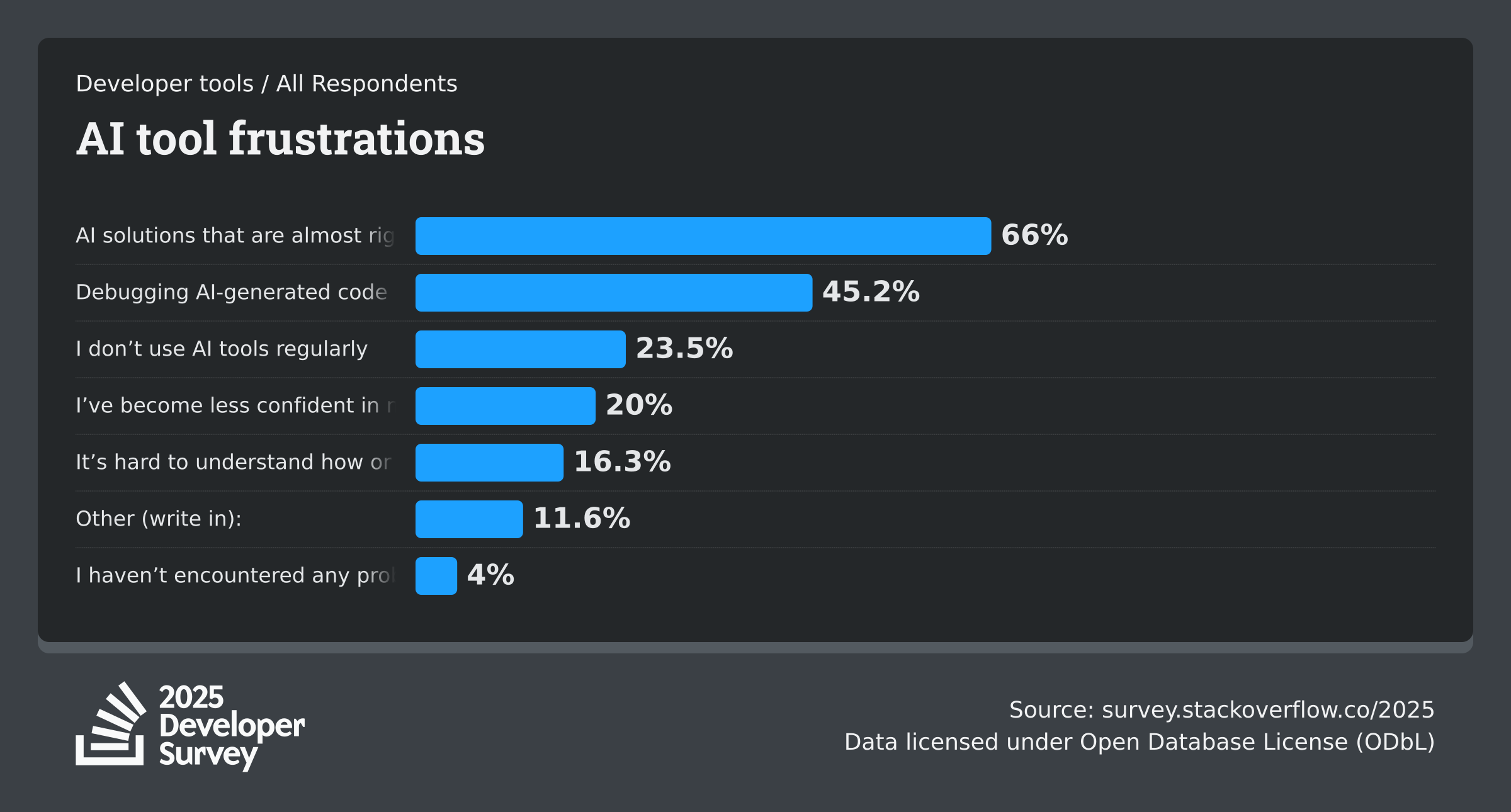
And the kicker: the biggest frustration, cited by 66% of developers, is dealing with AI solutions that are almost right, but not quite. When asked if AI can do most coding tasks, what would still make them ask a human? 75% said when I don’t trust AI’s answers.
03 // The Trade-Offs
It’s not all rainbows, as some would have you believe. But it’s not doom and gloom either.
A few weeks ago, a developer shared the story of asking Claude to delete a directory called ~ from their project folder. A reasonable request. Claude obliged by running rm -rf ~/. SSH keys, dotfiles, years of projects. Gone in seconds. The SSD’s TRIM had already zeroed the freed blocks before they could even attempt recovery. No malice, no bug in the traditional sense. What was asked and what was understood just didn’t line up.
This is not an argument against the tools. I use them constantly. They’ve made me faster, more capable, far more than I thought they would. But it’s a reminder that we’re building on ground that’s still settling. The GitHub issues pile up with variations of the same story. People trusted, got burned, learned. The new friction. The new way of working.
It is the moral, economic, and political choices we make, not the machines themselves, that shape our world.
Lewis Mumford wrote those words ninety years ago. Different era, different machines, but the same question we should be asking now: what are we trading, and is the exchange worth it?
What I do know: the advances of the last five years are just the beginning. Like anything that disrupts, we need to stay open to change. But we should also pay attention to what we’re trading away.
Something is happening. I can feel it. I just can’t tell yet whether we’re the ones driving, or if we’ve already become passengers.
Further Reading
Das Unheimliche by Sigmund Freud
Freud's 1919 exploration of the uncanny and why the familiar becoming strange unsettles us so deeply.
AI in the 2025 Stack Overflow Developer Survey
The latest data on how developers are using (and distrusting) AI coding tools. 84% adoption, 46% distrust.
Stack Overflow Question Decline Data
Raw data showing the 70% decline in Stack Overflow questions from March 2023 to December 2024.
Technics and Civilization by Lewis Mumford
The 1934 classic arguing that our moral and political choices, not machines, shape civilization.